
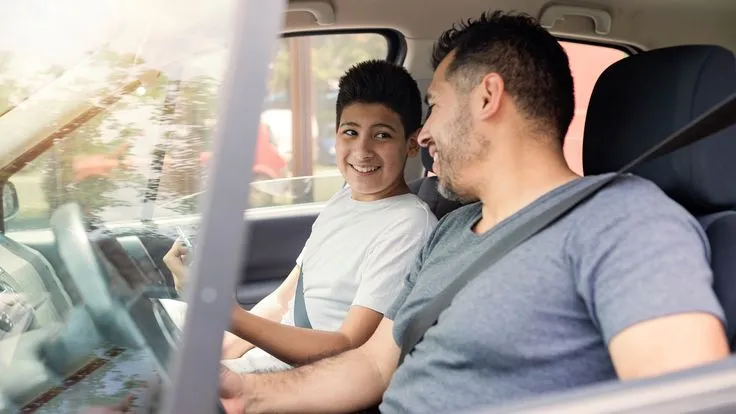
The Texas road test is more than just a test of traffic rules. Drivers should also have practical control, observation skills, good road positioning and be able to make appropriate decisions when driving. Learners can be identified as having weaker aspects and can be practiced in a structured way through professional lessons. Regular practice or training can make students more confident in dealing with everyday traffic situations and help them to achieve the skills required for their overall driving objectives.
Build Strong Vehicle Control
The basics of vehicle control may be the starting point of professional driving lessons. In order to handle more challenging road situations, learners should be familiar with how steering, braking, acceleration, and positioning all relate to one another.
Students can benefit from smooth starts, controlled stops, accurate turns and appropriate positioning of vehicles through the guidance of the instructor.
The basic skills are relevant because a driver must be able to drive the vehicle and at the same time see traffic, signs, signals and other road users.
Practice Real Road Situations
Practice driving should slowly be done on less quiet roads. Students can get used to intersections, lane changes, parking areas, larger roads and more traffic.
This variety assists students in becoming adaptable rather than taking just one familiar path.
Real-life experience also allows instructors to discover habits that are not apparent to the student. If these habits are corrected early, later practice will be more productive.
Improve Observation Skills
One of the key aspects of good driving is the constant scanning of the environment. Students must pay attention to traffic signs, lane markings, road markings, traffic, pedestrians, and traffic conditions.
Instructors can provide reminders during lessons of when observation should be enhanced and the things that should be observed before a specific maneuver.
These observations can be made more natural through repeated practice rather than something the learner has to remember separately every few seconds.
Work on Road Positioning
Another aspect of practical driving is the correct driving position. A learner should be aware of the position of the vehicle within the lane and how to change position during turns and other road circumstances.
If a pupil is continually driving too close to a line, turning too far or approaching an intersection from the wrong angle, the instructor can offer instant feedback.
Such changes can help make driving more predictable and controlled.
Practice Common Maneuvers
Practice maneuvers requiring coordination and awareness in lessons. These can be parallel parking, backing up, turns, stopping, lane changes, and more.
Requirements may vary depending on the Texas testing process that is applicable to the student, so students should check the current requirements with the appropriate Texas authority.
If a maneuver is not particularly challenging, it can be repeated for consistency and to minimize unneeded hesitation.
Learn From Instructor Feedback
A benefit of professional teaching is that you will get feedback from someone who can see the whole driving process.
A learner can be very focused on steering and not notice delayed signaling or not see enough. These issues can be identified by an instructor, along with a specific way to improve.
Feedback should be used as a learning tool, not a last-minute correction of bad habits in the final lessons.
Develop Independent Decision-Making
In the early lessons, a lot of directions are given by the teacher. The instructor can then fade the prompts and let the student make more decisions on his/her own as the learner gets better.
This is significant as real driving does not have a script. Drivers must determine when to slow down, when to move to the side of the road, when to move into or out of traffic lanes and how to react to other vehicles on the road.
Students can gain independent judgment skills which can assist in preparing them for real-world driving.
Use the DPS Road Test as a Preparation Goal
The DPS road test Texas process shouldn’t be considered as memorizing the way step by step. Rather, students should be taught to develop the practical skills required to appropriately react to various roadway scenarios.
Teachers can use this as a tool to pinpoint areas that need further practice and design a session to focus on these weaknesses.
Students must also check on the latest official testing information prior to the appointment to understand the procedures and requirements that apply to them.
Practice Without Overconfidence
As skills develop, pupils may feel more at ease on the wheel. Students should still be aware of the road conditions and feedback from the instructor, as confidence can be a helpful tool.
Don’t rush through practice because basic driving is easier. Work on areas of continued inconsistency.
The goal is continuous improvement, not finishing a number of lessons.
Conclusion
Driving lessons can help Texas learners practice vehicle control, observation, road positioning, practical driving skills and independent decision-making. Structured practice also provides students with chances to discover any weaknesses prior to their road test. Pupils should not just learn the route to be tested but develop skills which can be used in various traffic situations. When it comes to driving school training, there is a choice to be made: when preparing for the Texas licensing process, Myfirstdrive.net may be among the driving education options that are considered.
